What is tetrahexyldecyl ascorbate in skincare?
Tetrahexyldecyl ascorbate – usually shortened to THD ascorbate or THDA – is an oil-soluble ester of vitamin C. Attaching fatty chains to ascorbic acid makes it lipophilic, so it dissolves in the oil phase of a formula rather than the water phase.
That solves two problems at once. It is far more stable than pure L-ascorbic acid, and being oil-soluble it penetrates the lipid-rich barrier more readily. It also works at skin-friendly pH, so it does not sting the way a low-pH vitamin C serum can.
What skin concerns does tetrahexyldecyl ascorbate treat?
Once converted to ascorbic acid in the skin it does what vitamin C does: neutralises free radicals, inhibits tyrosinase to fade pigment, and supports collagen synthesis for firmness and fine lines.
It is a good fit for dry and sensitive skin that cannot tolerate L-ascorbic acid. One caveat from the stability literature is that THDA degrades quickly under some conditions despite its reputation, so packaging and formulation still matter.
What ingredients are best paired with tetrahexyldecyl ascorbate?
Vitamin E and ferulic acid support it as they do any vitamin C, and because it is oil-soluble it sits naturally alongside squalane, ceramides and facial oils.
It layers comfortably with niacinamide, peptides and retinoids, and it is gentle enough to use morning and night. As with all ascorbic acid derivatives, results depend on conversion in the skin, so give it three months before judging. Take our Skin Quiz.
What is uneven skin tone?
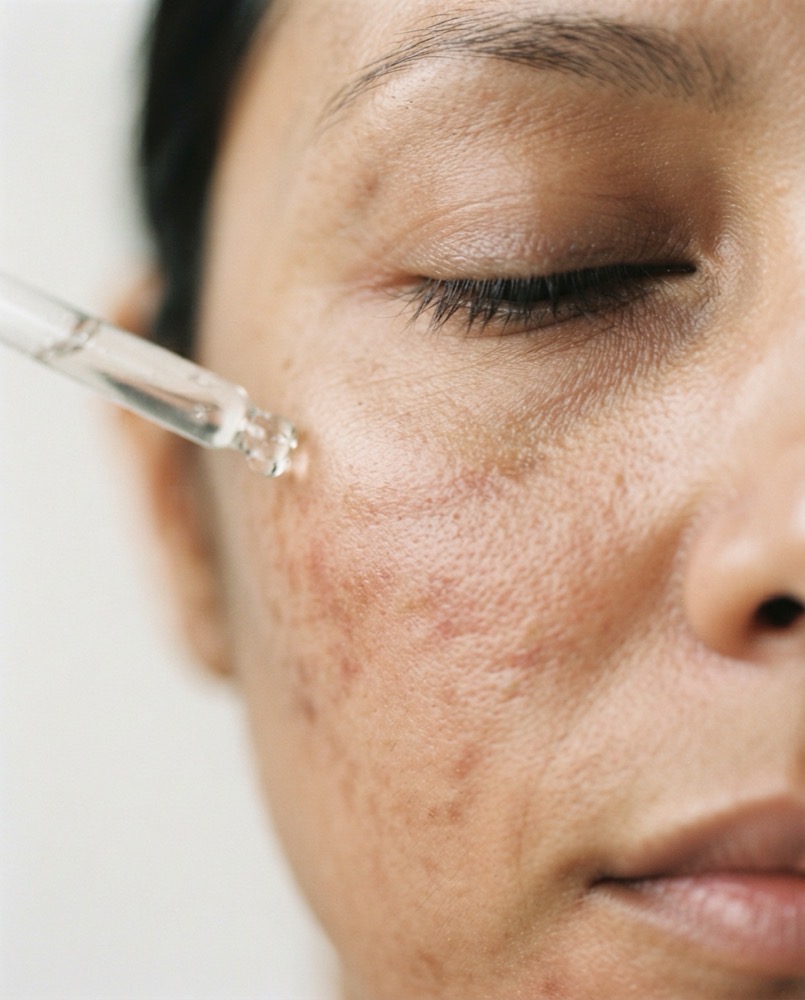
Uneven skin tone describes a complexion that reads patchy rather than uniform – a mix of darker and lighter areas, lingering red or brown marks, blotchy cheeks, and a general loss of clarity.
It usually combines several things at once: hyperpigmentation from sun or inflammation, persistent redness, and surface build-up of dead cells that makes the whole face look mottled and dull.
What causes uneven skin tone?
Ultraviolet exposure is the dominant cause, stimulating melanin unevenly across the face. Post-inflammatory marks from acne, eczema or irritation add brown or red patches that can persist for months.
Hormonal pigmentation, slowed cell turnover with age, dehydration, pollution, smoking and a damaged barrier all compound it. Aggressive scrubbing or unsupervised strong actives frequently make tone more uneven, not less.
What ingredients are best for uneven skin tone?
Vitamin C and niacinamide are the reliable everyday choices – one protects and brightens, the other evens tone and strengthens the barrier. Azelaic acid is unusually useful because it addresses brown marks and redness at once.
Add gentle exfoliation with lactic or glycolic acid to clear surface build-up, retinol to accelerate turnover, and alpha arbutin or tranexamic acid for stubborn pigment. Daily broad-spectrum SPF is what makes the results stick. Take our Skin Quiz.