

What is sugar in skincare?
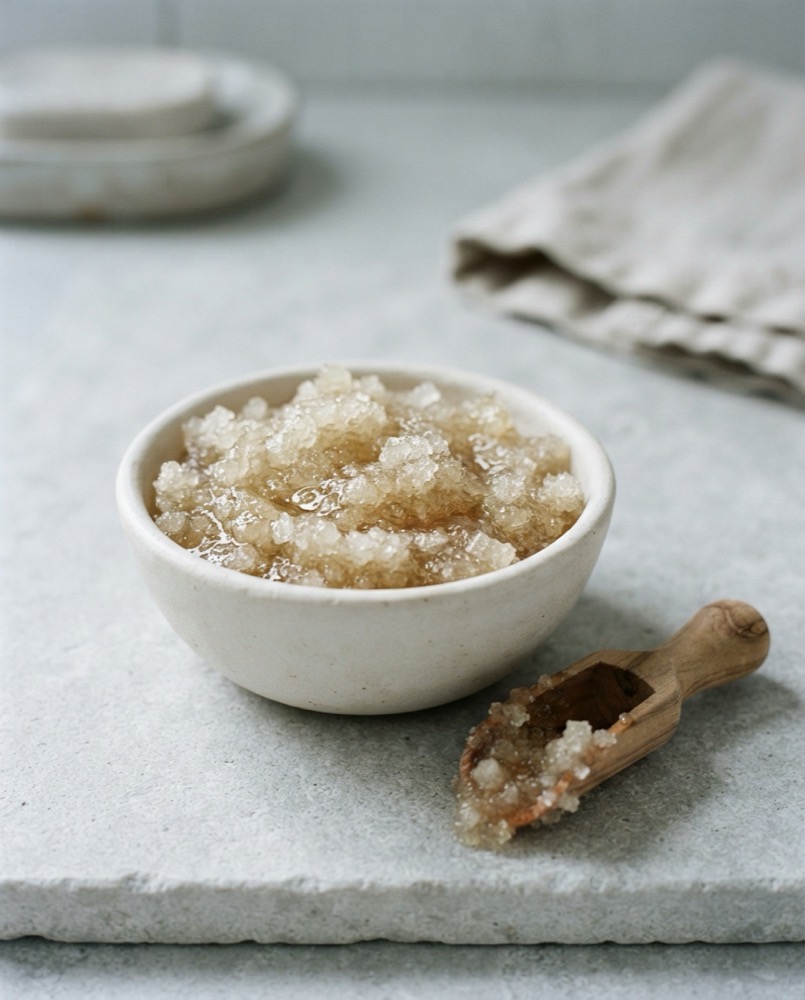
Sugar appears in skincare in two quite different roles. As granulated sucrose it is the base of countless body scrubs; as a chemical precursor it is where glycolic acid – the most studied alpha-hydroxy acid – originally comes from, extracted from sugar cane.
Sugar is also a natural humectant, which is why a sugar scrub leaves skin feeling softer than a salt one, and why honey and molasses behave the way they do on skin.
What skin concerns does sugar treat?
As a body scrub it lifts dead cells and smooths rough patches on elbows, knees and legs. Its crystals are rounder and dissolve faster than salt, so it is the gentler of the two physical exfoliants.
For the face, the derived acid is what matters. Glycolic acid resurfaces, brightens, fades pigmentation and stimulates collagen – none of which a sugar scrub does. Scrubbing facial skin with crystals creates micro-tears and inflammation instead.
What ingredients are best paired with sugar?
In a body scrub, combine it with an oil – coconut, almond, jojoba – which cushions the abrasion and moisturises as you rinse. Use it before shaving, not after, and never on broken or sunburnt skin.
For facial exfoliation, use a formulated AHA: glycolic acid for resilient skin, lactic acid for dry or sensitive skin, or a PHA if acids usually sting. All deliver what a scrub promises, without the mechanical damage. Take our Skin Quiz.

What are wrinkles?
Wrinkles are permanent folds and creases in the skin. They begin as dynamic lines that appear only with expression, then set into static lines visible at rest once the underlying support structure can no longer push them back out.
They form first where skin is thin and movement is constant: crow’s feet, forehead lines, frown lines between the brows, and nasolabial folds. Deeper folds also reflect loss of fat and bone volume, not just skin change.
What causes wrinkles?
Internally, collagen and elastin production declines steadily from the mid-twenties and the dermal matrix thins, so skin loses the scaffolding that keeps it smooth.
Externally, ultraviolet radiation does most of the damage – it activates enzymes that break down collagen and degrades elastic fibres. Smoking, pollution, sugar-driven glycation, poor sleep, sleeping position and repeated facial movement all accelerate the process.
What ingredients are best for wrinkles?
Retinoids have the deepest evidence base for stimulating collagen and measurably reducing wrinkle depth over six to twelve months. Vitamin C supports synthesis while neutralising the free radicals that break it down, and peptides signal repair.
Round it out with hyaluronic acid and ceramides for hydration and barrier strength, niacinamide for elasticity and tone, and AHAs for surface renewal. Daily broad-spectrum SPF is the most effective anti-wrinkle product there is. Take our Skin Quiz.