

What is sea salt in skincare?
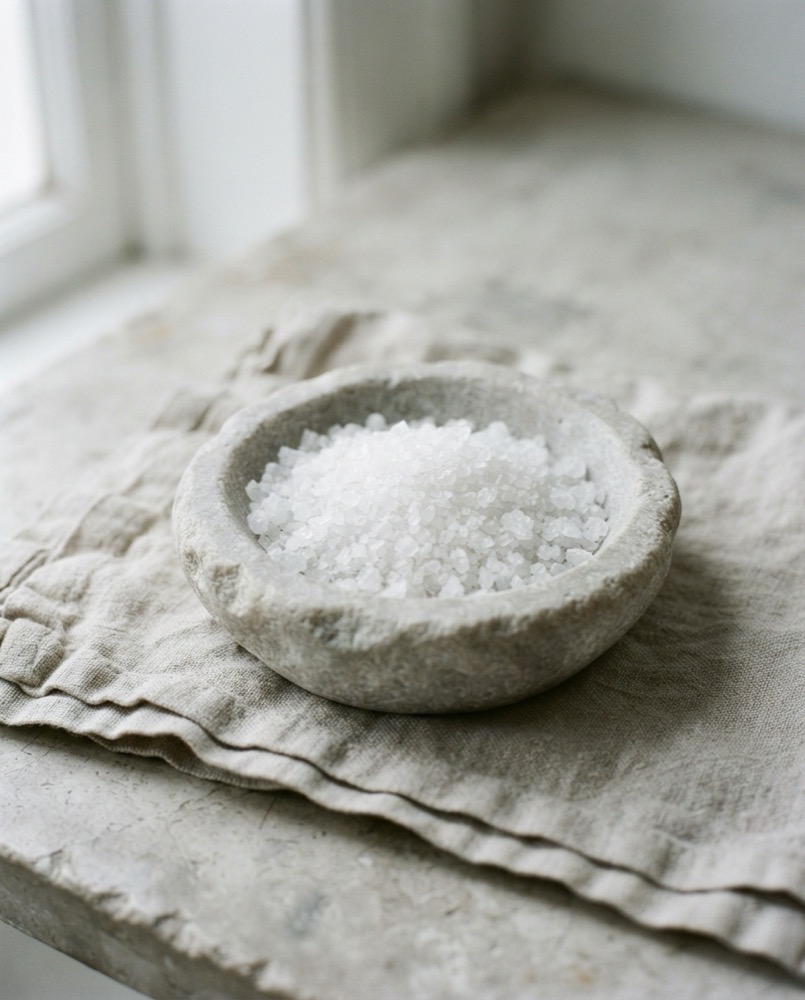
Sea salt is produced by evaporating seawater, which leaves sodium chloride along with trace minerals such as magnesium, potassium, calcium and zinc. It is coarser and less processed than table salt, and mineral content varies by source.
Dead Sea salt and Epsom salt are different products with different compositions – Epsom salt is magnesium sulphate, not a sodium salt at all – so claims made for one do not transfer to the others.
What skin concerns does sea salt treat?
Dissolved in a bath or used as a soak, salt water can ease itching and scaling in conditions such as psoriasis and eczema, and mineral-rich Dead Sea salt baths have been studied for barrier and inflammation benefits.
As a body scrub it removes dead cells effectively. On the face it is a poor choice: the crystals are sharp and irregular, they create micro-tears that let bacteria in, and salt draws water out of the skin, worsening dryness.
What ingredients are best paired with sea salt?
In body scrubs it is blended with oils – jojoba, almond, coconut – which cushion the abrasion and replace the moisture the salt pulls out. Always follow a salt scrub or soak with a moisturiser.
For facial exfoliation, lactic acid, glycolic acid or salicylic acid do the job without the mechanical damage. Never use a salt scrub on broken, sunburnt or freshly shaved skin. Take our Skin Quiz.

What are sun spots?
Sun spots are flat patches of concentrated pigment that form where skin has taken the most ultraviolet exposure – cheeks, nose, forehead, hands, shoulders and chest. Dermatologists call them solar lentigines; they are the same thing as age spots.
They are harmless, but they are a visible marker of accumulated photodamage, and they usually arrive alongside other signs of it: fine lines, loss of firmness and an uneven overall tone.
What causes sun spots?
UV radiation prompts melanocytes to produce extra melanin as a defence. With repeated exposure that response becomes localised and fixed, leaving discrete patches instead of an even tan that fades.
Tanning beds, sunburns in childhood, fair skin and outdoor time without protection all increase the count. Incidental exposure – driving, walking, sitting near a window – adds up more than most people expect.
What ingredients are best for sun spots?
Retinoids to accelerate turnover, vitamin C to protect and brighten, and pigment inhibitors such as alpha arbutin, kojic acid, azelaic acid, tranexamic acid and liquorice root are the core toolkit.
Gentle AHAs help shift surface pigment, and niacinamide slows the transfer of melanin into skin cells. None of it holds without daily broad-spectrum SPF and reapplication. Take our Skin Quiz.