What is hydroxyacetophenone in skincare?
Hydroxyacetophenone – usually 4-hydroxyacetophenone on a label – is a phenolic compound used mainly as an antioxidant and a preservative booster. It has little antimicrobial power on its own, but it makes preservatives like phenoxyethanol work harder, so formulators can use less of them.
It also stabilises the formula itself, slowing the oxidation that turns oils rancid and degrades delicate actives. That combination is why it turns up in so many otherwise minimal ingredient lists.
What skin concerns does hydroxyacetophenone treat?
It is chiefly a formulation ingredient rather than a treatment, but it is not inert. As an antioxidant it contributes to the free-radical defence of a product, and it has documented soothing activity on irritated skin.
More interestingly, laboratory work shows 4-hydroxyacetophenone acts as an antipigmentation agent by inhibiting tyrosinase, the key enzyme in melanin production – a secondary benefit for uneven tone, though not a reason to buy a product on its own.
What ingredients are best paired with hydroxyacetophenone?
It is almost always formulated with phenoxyethanol, caprylyl glycol or ethylhexylglycerin, whose preservative effect it amplifies.
It is well tolerated by most people, though allergic contact dermatitis has been reported in isolated cases, including a photo-aggravated reaction to it in a sunscreen. If you get unexplained reactions to products that share few other ingredients, it is worth noting as a candidate for patch testing. Take our Skin Quiz.
What are age spots?
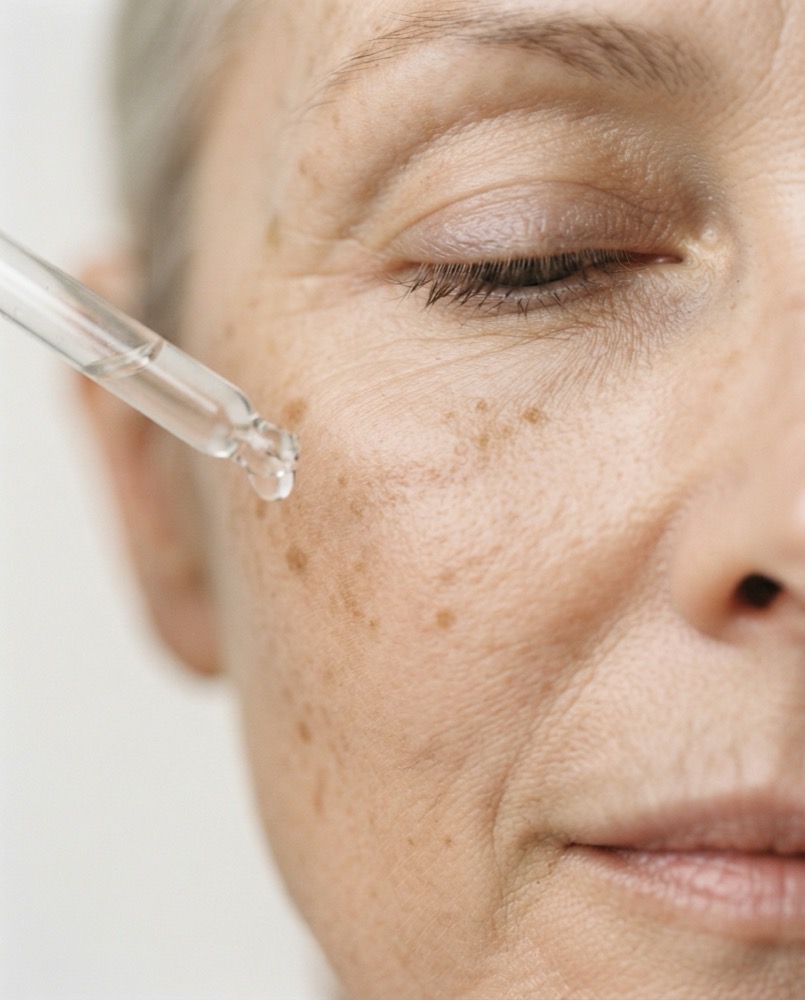
Age spots – known clinically as solar lentigines, and sometimes as liver spots – are flat, well-defined brown or tan patches that appear on skin with the most cumulative sun exposure: the face, backs of the hands, forearms, shoulders and upper chest.
Despite the name, they are not caused by age itself. They are a record of ultraviolet exposure, which is why they are common from the forties onward and why they cluster on areas that rarely get sunscreen.
What causes age spots?
Long-term UV exposure drives melanocytes to over-produce melanin in concentrated spots, and the surrounding keratinocytes stop clearing that pigment efficiently as skin ages.
Fair skin, a history of sunburns, tanning beds and outdoor work all raise the risk. Any new spot that changes shape, colour or size, bleeds or has an irregular border should be checked by a doctor rather than treated cosmetically.
What ingredients are best for age spots?
Topical treatment works but needs patience – expect three to six months. Retinoids speed turnover so pigmented cells shed faster, vitamin C and niacinamide brighten and protect, and alpha arbutin, kojic acid, azelaic acid and liquorice root inhibit new pigment.
Glycolic or lactic acid helps lift existing pigment from the surface. Daily broad-spectrum SPF, including on hands and chest, is what prevents new spots forming. Take our Skin Quiz.