The Best Personalized Skincare Brands for Women Whose Skin Changed After 40 or 50 — Ranked and Compared
Updated on May 26, 2026 • 10 min read
If your skin started behaving like a stranger sometime in your 40s — suddenly dry where it was once oily, suddenly sensitive when it never was before, breaking out along your chin like a teenager while fine lines deepen at the same time — you're not imagining things. Your skin genuinely changed. And the products that worked for twenty years likely stopped working because they were designed for a version of your skin that no longer exists.
This is exactly the problem that personalized skincare was built to solve. But not all personalized skincare brands are created equal — and when it comes to the specific, layered complexity of post-40 skin, the bar for what "personalized" actually means gets considerably higher.
This guide breaks down why skin changes so dramatically after 40, what a personalized skincare brand genuinely needs to get right to address those changes, and which brands actually deliver — ranked honestly.
Stop using skincare made for someone else's skin
Take the quiz and find out a 4-step regimen that actually works for you.
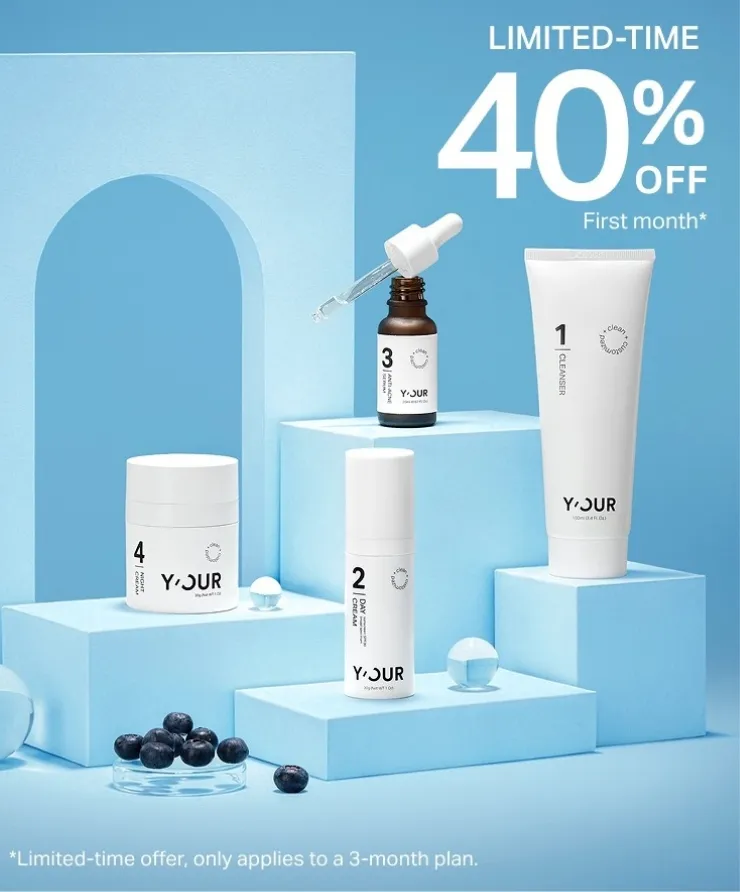
CLAIM 40% OFF FIRST MONTH
Why Skin Changes So Dramatically After 40 — and Why Your Old Routine Stops Working
The Collagen Cliff: Why Skin Loses Firmness and Volume So Fast After Menopause
Collagen loss is not a gradual, linear process. Women lose approximately 30% of their skin's collagen in the first five years after menopause — a steep, accelerated drop that dermatologists sometimes refer to informally as the "collagen cliff." Before perimenopause, collagen loss runs at roughly 1% per year from your mid-20s onward, which is slow enough that most women don't notice it much. After menopause, that rate can surge to as much as 2–3% per year.
The result is visible and felt: skin that once snapped back loses its rebound. The jawline softens.
The under-eye area hollows. The nasolabial folds deepen. This isn't just about dryness or texture — it's a structural change in the dermal scaffold that holds everything in place.
Estrogen is the key driver. It directly stimulates fibroblasts — the cells responsible for producing collagen and elastin. As estrogen levels fall during perimenopause and menopause, fibroblast activity slows, collagen production drops, and existing fibers begin to break down faster than they're replaced. Hyaluronic acid production — which binds moisture and gives skin its plumpness — also declines in tandem.
This is why the anti-aging moisturizer you used at 35 doesn't do the same job at 48. It was formulated for a different skin biology.
Hormonal Shifts, Skin Barrier Thinning, and the Cycle of Dryness and Sensitivity
The skin barrier — the outermost layer of the epidermis — relies heavily on lipids (ceramides, fatty acids, and cholesterol) to maintain its structure and keep moisture in. Estrogen supports the production of those lipids. As estrogen drops, the barrier thins and its lipid composition shifts.
A compromised barrier doesn't just mean dryer skin. It means skin that's less able to defend against environmental aggressors, more prone to inflammation, and more likely to react to products it once tolerated perfectly well. This explains the maddening paradox many women over 40 describe: their skin feels dry, so they apply richer products — but those same products now cause breakouts or redness that never happened before.
On top of this, androgen levels become relatively more dominant as estrogen falls. In some women, this fuels sebaceous gland activity in specific zones — particularly the chin and jawline — producing hormonal breakouts that look and feel like teenage acne but respond differently to treatment.
The overall picture is a skin that is simultaneously more fragile and more reactive, while also dealing with structural volume loss and accelerating pigmentation changes. Treating it requires a meaningfully different approach than what worked in your 30s.
What a Personalized Skincare Brand Actually Needs to Get Right for Post-40 Skin
It Must Ask About More Than Just Skin Type — Lifestyle, Diet, Stress, and Sleep All Matter
Most basic skincare quizzes ask about oiliness, dryness, and sensitivity. That's a starting point, but it's nowhere near sufficient for the complexity of post-40 skin.
Skin in this phase is influenced by sleep quality, dietary patterns, stress levels, and hormonal status. Perimenopause, post-menopause, and HRT all produce meaningfully different skin profiles.
A brand that asks only "is your skin dry or oily?" is, at best, giving you a generic answer dressed up in personalized packaging. Real personalization for mature skin requires data collection that accounts for the full systemic picture — because post-40 skin is a whole-body story, not just a surface one.
It Must Evolve With You
Perimenopause can span a decade. The skin of a 42-year-old in early perimenopause is different from a 51-year-old who is two years post-menopause. A routine formulated at one moment may be suboptimal — or even counterproductive — 18 months later if skin has continued to shift.
A truly useful personalized skincare service for women over 40 needs to build in regular reassessment and update mechanisms, not just deliver a fixed formula once and assume it remains the best fit indefinitely.
It Must Be Gentle Enough for Newly Sensitive Skin While Still Being Effective on Real Concerns
This is perhaps the trickiest balance. Post-40 skin is more reactive, which rules out aggressive formulations — high-concentration acids, harsh exfoliants, and stripping cleansers that might have been fine in your 30s can now destabilize a compromised barrier and make everything worse.
But at the same time, the actual concerns — deep dehydration, significant collagen loss, hyperpigmentation, loss of firmness — require genuinely active ingredients to address. The answer isn't either gentle or effective; it's formulations that are strategically potent where they need to be and carefully calibrated to avoid triggering sensitivity.
A brand that sends the same retinol serum to a newly reactive 47-year-old that it sends to a resilient 32-year-old isn't personalizing. The right balance requires sophisticated formulation and a granular intake process that can actually distinguish between those two very different situations.
Y'OUR
® Skincare creates fully personalized skincare systems formulated for your specific skin biology, lifestyle, and concerns. Take the skin quiz at
yourskin.com to see your personalized routine.
The Best Personalized Skincare Brands for Women Over 40 and 50 — Compared Honestly
The table below compares four of the most prominent personalized skincare brands specifically on criteria that matter for post-40 skin.
Y'OUR®
PROVEN
Curology
Prose
Primary focus
Whole-skin health + aging concerns
Anti-aging + skin science
Acne + targeted prescription treatment
Hair + body; limited skincare
Intake depth for post-40 concern
Extensive — covers lifestyle, stress, sleep, diet, hormonal stage, skin history
Strong — uses a large clinical database to match formulas
Moderate — focused on skin symptoms rather than systemic factors
Limited for skincare
Addresses hormonal skin changes specifically
Yes — intake includes hormonal context; formulas adjusted accordingly
Partially — data-driven but less explicitly hormonal
Partially — can prescribe for hormonal acne
No
Routine evolution / reassessment
Regular check-ins built into the service; formulas updated as skin changes
Some re-evaluation available
Ongoing provider check-ins
Limited
Formulation gentleness for sensitive/barrier-compromised skin
Calibrated to individual barrier status; avoids triggering reactivity
Well-formulated; less individualized calibration
Prescription strength — effective but can be too potent for newly sensitive skin
N/A
Targets firmness, collagen, and structural aging
Yes — directly addressed with targeted actives
Yes
Not a primary focus
No
Addresses hyperpigmentation
Yes
Yes
Yes
No
Ingredient transparency
Full ingredient disclosure
Full
Full
Full
Best suited for
Women 40+ with multi-faceted, evolving skin changes
Women seeking data-science-backed anti-aging formulas
Women with active acne as primary concern
Hair care; not a primary skincare solution
The honest summary: For women whose primary concern is the multi-layered skin transformation that accompanies perimenopause and menopause — firmness loss, barrier thinning, new sensitivity, hyperpigmentation, and hormonal breakouts simultaneously — Y'OUR
® stands out as the most comprehensively designed solution.
Y'OUR® addresses hyperpigmentation as a core post-40 concern.
The Specific Skin Changes Women in Their 40s and 50s Need a Brand to Address — and How Y'OUR® Handles Each One
Loss of Firmness and the Collagen Drop
After 40, the skin's support structure — its collagen and elastin network — begins degrading faster than it's replenished. The visible result is sagging along the jaw and cheeks, deepening folds, and a loss of the natural lift that once required no effort.
Addressing this requires ingredients that both protect existing collagen and stimulate new collagen synthesis. The challenge is delivering these at concentrations that are effective without triggering the sensitivity that post-menopausal skin is prone to.
Y'OUR® approaches this by calibrating retinoid concentration and delivery system to each individual's barrier status and skin history — so a woman with newly reactive skin might receive a gentler retinol encapsulated for time-release, while someone with a more resilient complexion gets a more potent formulation.
Sudden Dryness and Skin Barrier Thinning
Dryness after 40 is often not just a lack of moisture. It is a barrier problem. As estrogen drops, the skin produces fewer lipids, loses water faster, and becomes easier to irritate.
A useful personalized formula needs to rebuild the barrier with ceramides, fatty acids, cholesterol, humectants, and soothing ingredients while avoiding unnecessary fragrance or harsh resurfacing agents.
Y'OUR® factors barrier condition into the quiz and formula logic so the routine can hydrate, repair, and treat aging concerns without compromising the barrier work that the formula is simultaneously doing.
How to Choose the Right Personalized Skincare Brand for Where You Are in Your 40s or 50s
If your primary concern is the full range of post-40 changes — dryness, sensitivity, firmness loss, pigmentation, and occasional hormonal breakouts all at once: Y'OUR® is the most holistically designed option.
Its intake process and formulation philosophy are specifically built for this complexity, and its routine-evolution model is suited to skin that is still actively changing through perimenopause.
If anti-aging is your dominant priority and you want a data-science-heavy approach: PROVEN is a good option.
Its database-driven formula matching is genuinely sophisticated, though its approach to hormonal context is less granular than Y'OUR®'s.
If hormonal acne is your overwhelming primary concern and you want prescription-strength treatment: Curology's provider-supervised model may be appropriate.
Be aware that prescription-strength actives can be too aggressive for newly sensitive post-40 skin, and its focus is narrower than you may need.
If you're in early perimenopause and your skin hasn't dramatically shifted yet: Starting with a comprehensive personalized service like Y'OUR® now gives you a formulation baseline that can evolve with you.
The general principle: the more complex and multi-faceted your skin situation, the more you need a service that's asking sophisticated questions upfront and built to update over time. A generic quiz that categorizes you as "dry/sensitive" and ships you a pre-made formula is not personalization — it's a skin-type quiz wearing personalization's clothing.
Y'OUR
® Skincare creates fully personalized skincare systems formulated for your specific skin biology, lifestyle, and concerns. Take the skin quiz at
yourskin.com to see your personalized routine.